Primary research and veterinary guidance reviewed July 28, 2026 · Theories are labeled as theories
Some cats sprint after using the litter box, while some dogs sniff and circle before choosing a toilet spot. Both can be normal rituals. Research has not proved one universal cause for either behavior, and the catchy internet explanations often run ahead of the evidence. The important clues are comfort, successful stool passage, and whether the pattern suddenly changes.
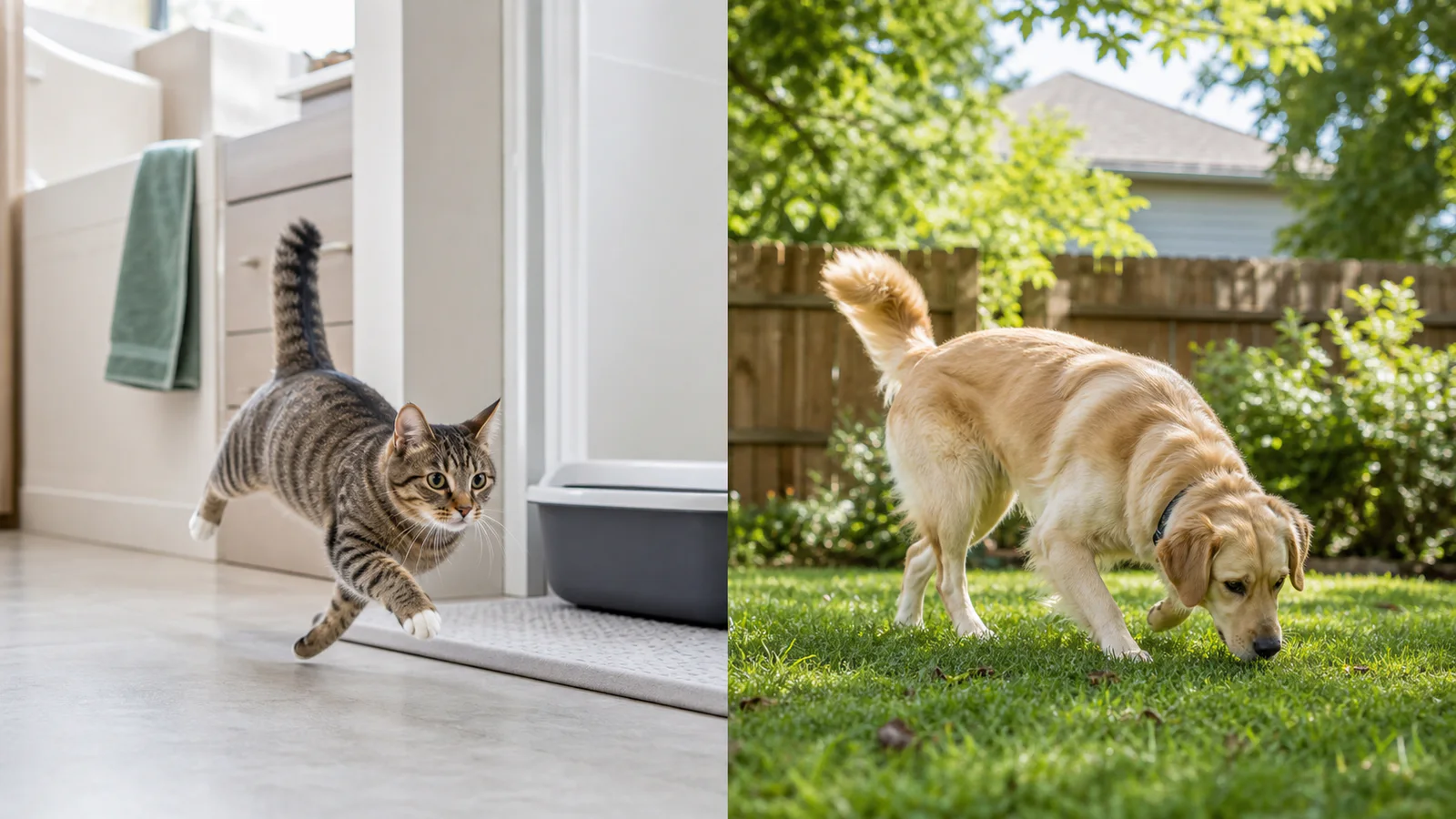
Same bathroom, opposite timing
| Pet | Common timing | What is observed | What is actually known |
|---|---|---|---|
| Cat | Immediately after the litter box | A short burst of running, jumping, or energetic play | Post-elimination sprints are observed, but no single cause has been established |
| Dog | Before squatting | Sniffing, pacing, turning, and repositioning | Dogs gather information and select a spot; research has not isolated one reason for the circles |
The comparison is useful because it prevents a common mistake: treating two funny-looking rituals as if they share one mechanism. The cat's behavior usually comes after elimination; the dog's comes before. Mirror-image timing does not equal a shared bathroom committee.
Why does my cat get zoomies after pooping?
A zoomie is a descriptive label for a sudden burst of energetic movement. It does not name a diagnosis or explain the cause. Research on feline elimination shows that using a litter box is a complex, context-sensitive behavioral sequence. One published ethogram catalogued dozens of actions before, during, and after elimination, including sniffing, digging, posturing, covering, and leaving. The study helps show how much behavior surrounds the event; it did not prove why some cats sprint afterward.
Popular cat theories, graded honestly
Relief or arousal
A change from toileting to high activity is plausible, but “the cat feels euphoric” has not been demonstrated as the universal cause.
Habit and transition
A repeated dash can become part of an individual cat's routine. Plausible does not mean experimentally proved.
Litter-box conditions
A dirty, cramped, noisy, or poorly located box may make a cat leave quickly. That explanation fits some homes, not every sprint.
Vagus “poophoria”
The phrase is memorable. Cat-specific evidence proving vagus nerve stimulation causes post-poop zoomies is not.
The predator-escape story is also popular: the cat supposedly runs so predators cannot follow the scent. It is an interesting evolutionary narrative, but it is not an established explanation for domestic cat zoomies. A good oddity page should be fun without upgrading a theory into a fact because it wore a convincing costume.
Why does my dog spin before pooping?
Many dogs sniff, pace, circle, and reposition before eliminating. The simple observation is defensible: dogs inspect the location and adjust their body before squatting. Specific claims about why—flattening grass, checking for danger, stimulating the bowel, choosing scent, or finding comfort—remain difficult to separate and may vary by dog and setting.
Scent communication is relevant to canine elimination. Research has examined defecation and ground scratching as parts of scent-marking behavior. That does not prove the pre-poop circle itself is a scent-marking maneuver. Your dog may be collecting information, choosing footing, following a personal ritual, or doing several things at once.
What about the “dogs face north” study?
A 2013 study recorded the body alignment of 70 dogs during 1,893 defecations and reported a north-south preference under calm geomagnetic conditions. Fascinating? Absolutely. Proof that a dog circles to find north? No. The study measured the dog's final body axis during elimination, not the reason for the preceding turns.
A later study observing dogs in urban parks did not detect magnetic alignment and noted that environmental features and distractions can affect orientation. The responsible conclusion is that magnetic sensitivity remains an interesting research question, not the answer to “why has Baxter completed six laps around one blade of grass?”
Normal ritual or veterinary clue?
A brief, familiar ritual followed by comfortable, normal stool and a quick return to baseline is usually less concerning than a sudden change. There is no universal number of circles and no stopwatch cutoff for cat zoomies. Compare the behavior with your pet's own normal pattern.
Get advice for repeated unsuccessful attempts to defecate, obvious straining, pain or vocalizing, very hard or bloody stool, diarrhea that persists, vomiting, lethargy, appetite change, a swollen or painful abdomen, litter-box avoidance, or a sudden major change in the ritual. Do not give a human laxative or enema unless a veterinarian specifically directs it.
A cat that bolts before finishing, cries, repeatedly enters and exits the box, or develops stool changes may be reacting to discomfort rather than celebrating. A dog that circles repeatedly but cannot pass stool may be constipated or have another problem. In both species, the useful question is not “Is this weird?” Pets have already won that category. Ask “Is this new, uncomfortable, unsuccessful, or paired with other changes?”
A useful bathroom-behavior log
- Record whether the behavior happens before, during, or after elimination.
- Note stool frequency, consistency, color, and whether passage appears comfortable.
- For cats, record litter type, box cleanliness, box size, and any recent location change.
- For dogs, note surface, weather, leash tension, distractions, and whether the normal spot was available.
- Film a short clip when safe. Include the full sequence rather than only the funniest three seconds.
- Share sudden changes and the log with your veterinarian.
Frequently asked questions
Does the vagus nerve cause cat zoomies after pooping?
No cat-specific research has established it as the cause. Relief or a change in arousal may be plausible, but the popular “poophoria” explanation should remain labeled as a theory.
Do dogs spin before pooping to face north?
The magnetic-field study measured final body orientation during elimination, not why dogs spin. A later urban replication did not find the same alignment. North is an intriguing sidebar, not a training cue.
How many circles is too many?
No universal number exists. A sudden increase, a ritual that looks uncomfortable, or repeated circling without producing stool matters more than an arbitrary lap count.
Why does my cat run out before finishing?
Pain, urgency, diarrhea, constipation, box aversion, or another medical or environmental problem can interrupt elimination. That is different from a normal post-box sprint and deserves veterinary advice.
Final answer
Cats may sprint after pooping; dogs may circle before it. Both rituals can be normal, but neither has one proved explanation. Enjoy the harmless choreography, keep the litter box and yard setup comfortable, and pay attention when the routine becomes new, painful, or unsuccessful. Bathroom mystery solved? Partly. Bathroom monitored intelligently? Much better.
Sources and further reading
These primary studies and veterinary resources support the evidence boundaries and warning signs above.
- McGowan and colleagues: A detailed ethogram for feline elimination behavior
- AAFP and ISFM guidelines for diagnosing and resolving house-soiling behavior in cats
- Cornell Feline Health Center: House-soiling and medical causes
- Merck Veterinary Manual: Constipation, obstipation, and megacolon
- Hart and colleagues: Dogs are sensitive to small variations of the Earth's magnetic field
- Rouviere and Ruxton: Urban replication of canine magnetic alignment
- McGuire: Scent-marking behavior in shelter dogs